Introducing Kurrier: An Open Source Email Platform Built for Developers
We’re building an open-source email platform that combines transactional email, webmail, storage, calendars, contacts and APIs into one self-hostable stack.
Email remains one of the most important communication protocols on the internet, yet the software around it has become increasingly fragmented. One service sends email, another receives it, another stores attachments, another syncs calendars, and another provides a webmail interface. Integrating these pieces often means stitching together multiple providers, APIs, and databases before you can build even a basic email application. We started Kurrier with a simple goal: to bring these capabilities together into a modern, open-source platform that developers can self-host, extend, and build upon.
Why another email platform?
Email is one of the oldest and most successful open standards ever created. SMTP, IMAP, POP3, CalDAV, CardDAV, JMAP, and WebDAV have enabled billions of people and businesses to communicate across providers for decades. The protocols themselves aren’t the problem.
The problem is the developer experience.
If you want to build anything beyond sending an email, you quickly find yourself stitching together multiple products. You might use Amazon SES or Postmark for outbound mail, IMAP for reading messages, CalDAV for calendars, CardDAV for contacts, object storage for attachments, Redis for queues, and several databases to tie everything together. Each component solves a small piece of the puzzle, but very few solutions provide a cohesive platform that developers can build upon.
For most teams, this means spending weeks integrating infrastructure before writing the features that actually matter to their users.
What is Kurrier?
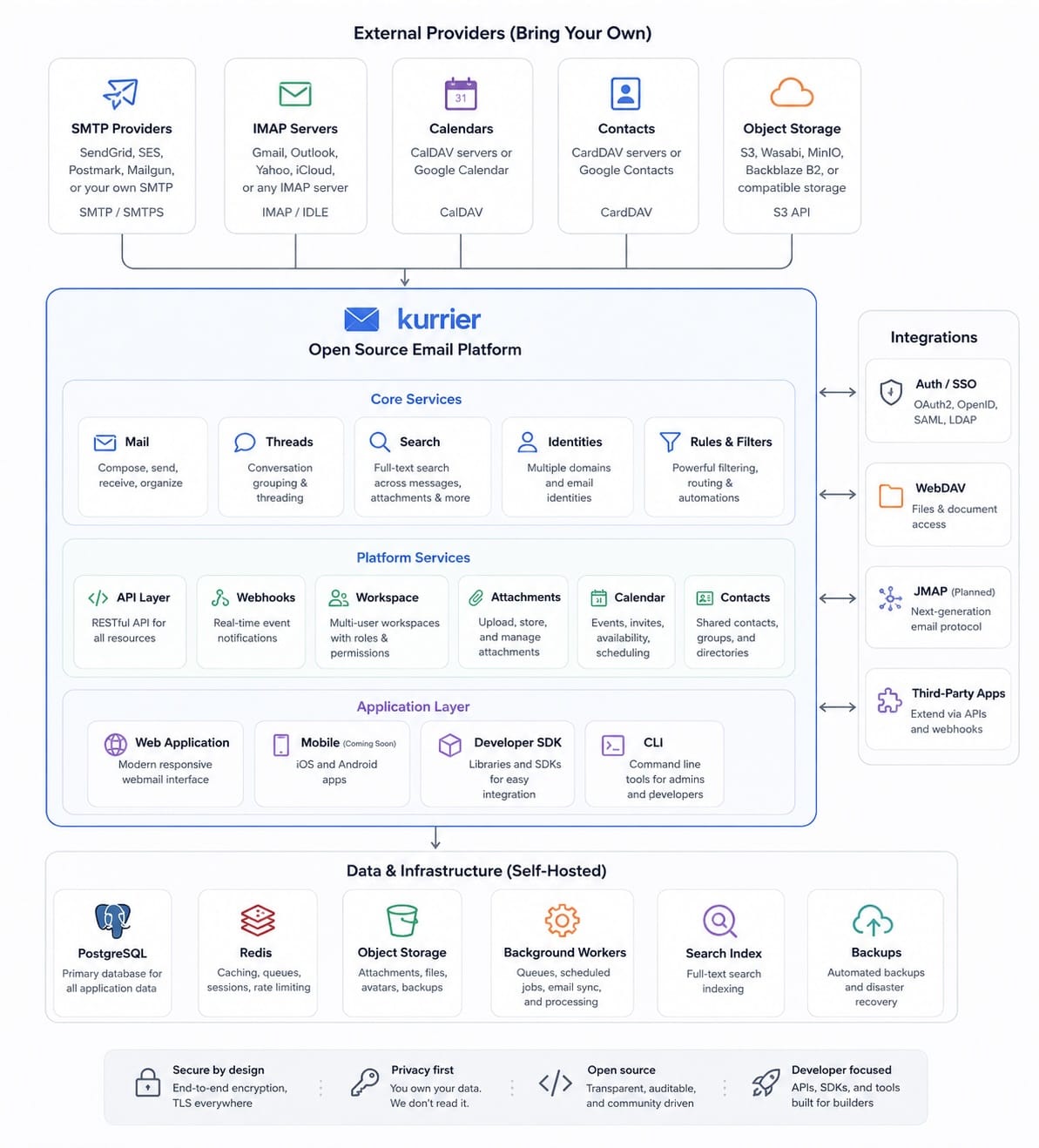
Kurrier is our attempt to change that. Rather than replacing the protocols that already work, we’re building a modern platform around them. Kurrier acts as the glue between SMTP providers, IMAP servers, calendars, contacts, object storage and developer APIs, exposing them through a consistent interface that can be self-hosted or extended as needed.
Whether you’re building an internal company mailbox, a transactional email platform, a customer support inbox, or a complete webmail experience, the underlying infrastructure should already exist. Developers should focus on their application, not on wiring together half a dozen independent systems.
Built on open standards
One of Kurrier’s core design principles is that it should work with the infrastructure you already have.
If your organization already uses Amazon SES, Postmark, Mailgun, SendGrid, Gmail, Microsoft 365, or a traditional SMTP server, Kurrier doesn’t ask you to migrate. Instead, it connects to your existing providers and builds a modern developer platform on top of them.
The same philosophy extends to every other part of the stack. Existing IMAP servers become searchable mailboxes, existing CalDAV servers become calendars, CardDAV servers become contacts, and object storage providers become attachment storage. Rather than inventing new protocols, Kurrier embraces the standards that have proven themselves over decades.
This means you remain in control of your infrastructure while gaining a unified API, a modern web interface, and a consistent data model across every service.
A Modular Architecture
Kurrier is intentionally modular.
Every component can be replaced, extended, or disabled depending on your deployment. Need to use Amazon SES for outbound mail? That’s fine. Prefer your own SMTP server? That works too. Want to sync Gmail, Exchange, or a self-hosted IMAP server? They’re simply different providers behind the same interface.
Internally, Kurrier treats email, calendars, contacts, storage, identities, providers, and APIs as independent services connected through a shared workspace model. This allows developers to build anything from a lightweight webmail client to a complete collaboration platform without being locked into a particular vendor.
At the same time, the entire stack can be self-hosted, making it suitable for organizations that require complete control over their infrastructure and data.
What can you build with Kurrier?
Kurrier isn’t just another webmail client. It’s an application platform for email.
Because every service shares the same workspace, identity, permissions, and API model, developers can build products that would normally require integrating half a dozen different systems.
Some examples include:
- Modern webmail with threading, search, attachments, multiple identities, and shared inboxes.
- Transactional email platforms backed by Amazon SES, Postmark, Mailgun, or your own SMTP infrastructure.
- Customer support systems with routing, labels, assignments, and conversation history.
- Team collaboration tools combining email, calendars, contacts, and file storage.
- Internal company mail systems for organizations that need complete control over their infrastructure.
- Developer platforms exposing every resource through APIs, webhooks, SDKs, and automation.
Whether you’re building an internal tool or the next generation of email software, Kurrier provides the foundation so you can focus on your application rather than rebuilding email infrastructure.
Why open source?
Email is critical infrastructure. We believe infrastructure should be transparent.
Every line of Kurrier is developed in the open. You can inspect the code, deploy it yourself, extend it with plugins, or contribute improvements back to the community.
Open source also means you’re never locked into a hosted service. You own your data, your infrastructure, and your deployment model.
If you simply want a hosted version, we’ll provide that too - but the software itself will always remain available for developers who want full control.
Self-hosted or Hosted - Your Choice
Kurrier is, and will remain, open source. You can deploy it on your own infrastructure, connect it to your existing providers, and customize every aspect of the platform.
For developers and organizations that don’t want to manage their own deployment, we’re also building KurrierMail our fully managed hosted service. It provides the same modern experience without the operational overhead of maintaining servers, updates, backups, or infrastructure.
Whether you choose to self-host with Kurrier.io or use KurrierMail, the goal is the same: give you complete control over your email stack without vendor lock-in.
Learn more about the open-source project at Kurrier.io, or join the waitlist for the hosted platform at KurrierMail.
The Road Ahead
Kurrier is still in active development, but the vision has remained the same from day one: make building modern email applications dramatically simpler.
Over the coming months we’ll be publishing deep dives into the architecture, implementation details, design decisions, and engineering challenges behind the project. We’ll also document how features like Gmail synchronization, IMAP support, full-text search, threading, workspace permissions, CalDAV, CardDAV, and JMAP are implemented.
If you’re interested in building on open standards - or simply curious about how modern email systems work - we’d love for you to follow along.
Welcome to Kurrier.